
A geothermal heat pump needs a reliable heat source and heat sink. The loop field provides that connection, but the available land or water, installation access, subsurface conditions, permitting and restoration can change which approach makes sense.
QUICK COMPARISON
Start with the physical property.
| Loop type | Typical surface requirement | Verify first | Current payment path |
|---|---|---|---|
| Vertical bore | Small surface footprint; drilling access required | Rig access, utilities, geology, bore depth, spacing and grout | PremiumPath preliminary pathway Final program, project, property, design and credit review required. |
| Horizontal slinky | Larger open excavation area | Usable land, soil moisture, trench spacing, septic and restoration | PremiumPath preliminary pathway Final program, project, property, design and credit review required. |
| Horizontal directional bore | Entry and exit areas with less continuous trenching | Bore path, locating, utilities, bend radius and drilling-fluid control | PremiumPath preliminary pathway Final program, project, property, design and credit review required. |
| Open loop / well | Well and approved discharge locations | Sustainable yield, drawdown, chemistry, pumping energy and discharge legality | Cash purchase or traditional financing This loop type is not currently included in PremiumPath. |
| Pond / lake loop | Suitable water body plus protected shore crossing | Ownership, seasonal depth, volume, anchoring, ecology and shoreline access | Cash purchase or traditional financing This loop type is not currently included in PremiumPath. |
COMPACT CLOSED-LOOP DESIGN
Vertical bore
Deep, narrow boreholes exchange heat with the earth while preserving most of the usable yard. The small surface footprint makes vertical loops a frequent retrofit choice.
Smaller lots, established landscaping, limited trench area, and projects where drilling access can be safely established.
- Small surface footprint
- Works on many retrofit lots
- Less broad excavation and restoration
- Specialized drilling access and mobilization
- Subsurface uncertainty
- Higher drilling cost in difficult formations
Vertical bore is one of the closed-loop types currently included in this site’s preliminary WaterFurnace PremiumPath screen. Final program eligibility still depends on equipment, engineering, property, credit, documentation and current PremiumPath/Palmetto rules.
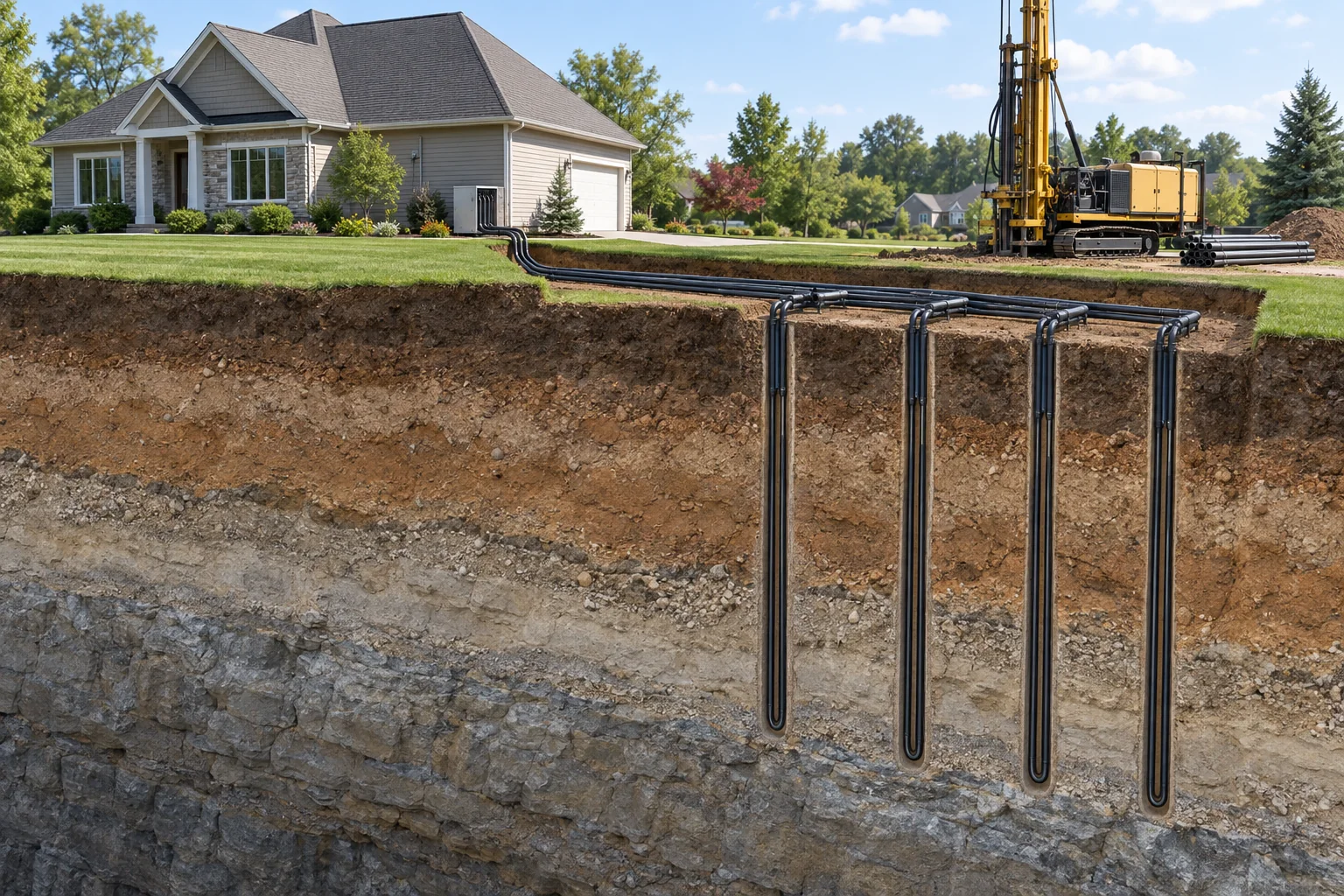
A simplified, not-to-scale view of how vertical U-bend loops and headers may relate to a home. This is not a West Jefferson jobsite photo or an engineered layout.
COILED CLOSED-LOOP FIELD
Horizontal slinky
Coiled polyethylene pipe is placed in engineered trenches to fit more pipe length into each run. Slinky fields can be useful when adequate open ground and excavation access are available.
Larger open lots with suitable soil, manageable restoration and enough separation from utilities, septic systems, structures and protected areas.
- Avoids deep drilling
- Can use conventional excavation equipment
- Efficient pipe placement per trench
- Needs meaningful open land
- Large disturbed and restored area
- Performance is sensitive to depth, spacing, moisture and soil
A closed-loop horizontal slinky field is included in this site’s preliminary PremiumPath screen as a horizontal-trench concept. Final documentation, design, property, pricing and credit review still control.
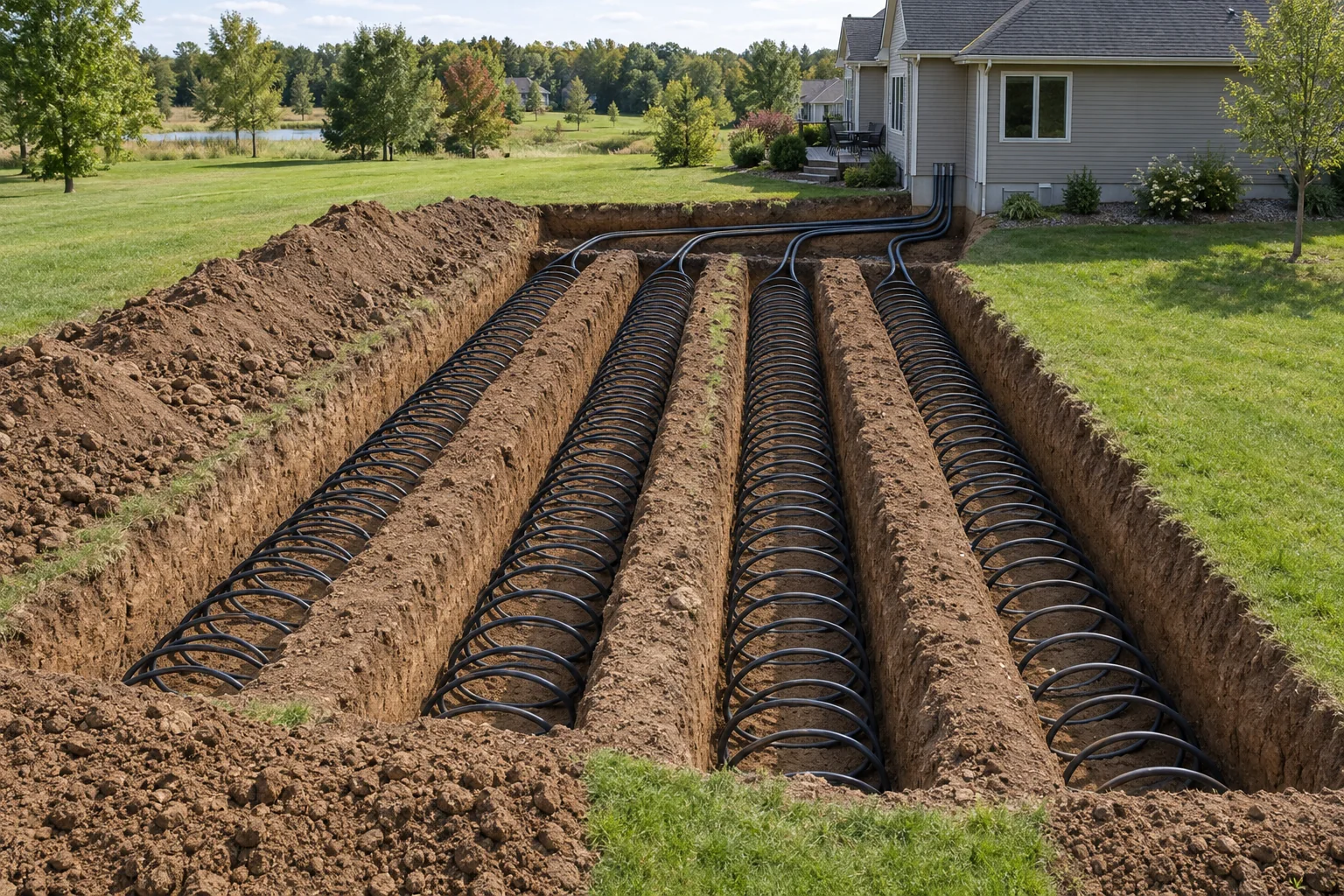
A simplified, not-to-scale view of coiled geothermal pipe in parallel trenches. Actual trench count, depth, spacing, coil pitch and routing require site-specific engineering.
LOWER-SURFACE-DISTURBANCE OPTION
Horizontal directional bore
A directional drilling system advances underground loop paths from compact entry and exit areas. It can cross beneath established surfaces while reducing continuous trenching.
Sites where surface disruption matters and a qualified directional-drilling contractor can establish safe bore paths, setbacks and locating control.
- Less continuous surface excavation
- Can pass beneath drives or established areas
- Smaller restoration zones
- Specialized equipment and locating skill
- Subsurface obstructions can change the plan
- Entry/exit pits and drilling fluid still require management
Horizontal directional bore is included in this site’s preliminary WaterFurnace PremiumPath screen. Final program eligibility still depends on qualifying equipment, engineering, property, credit, documentation and current PremiumPath/Palmetto rules.
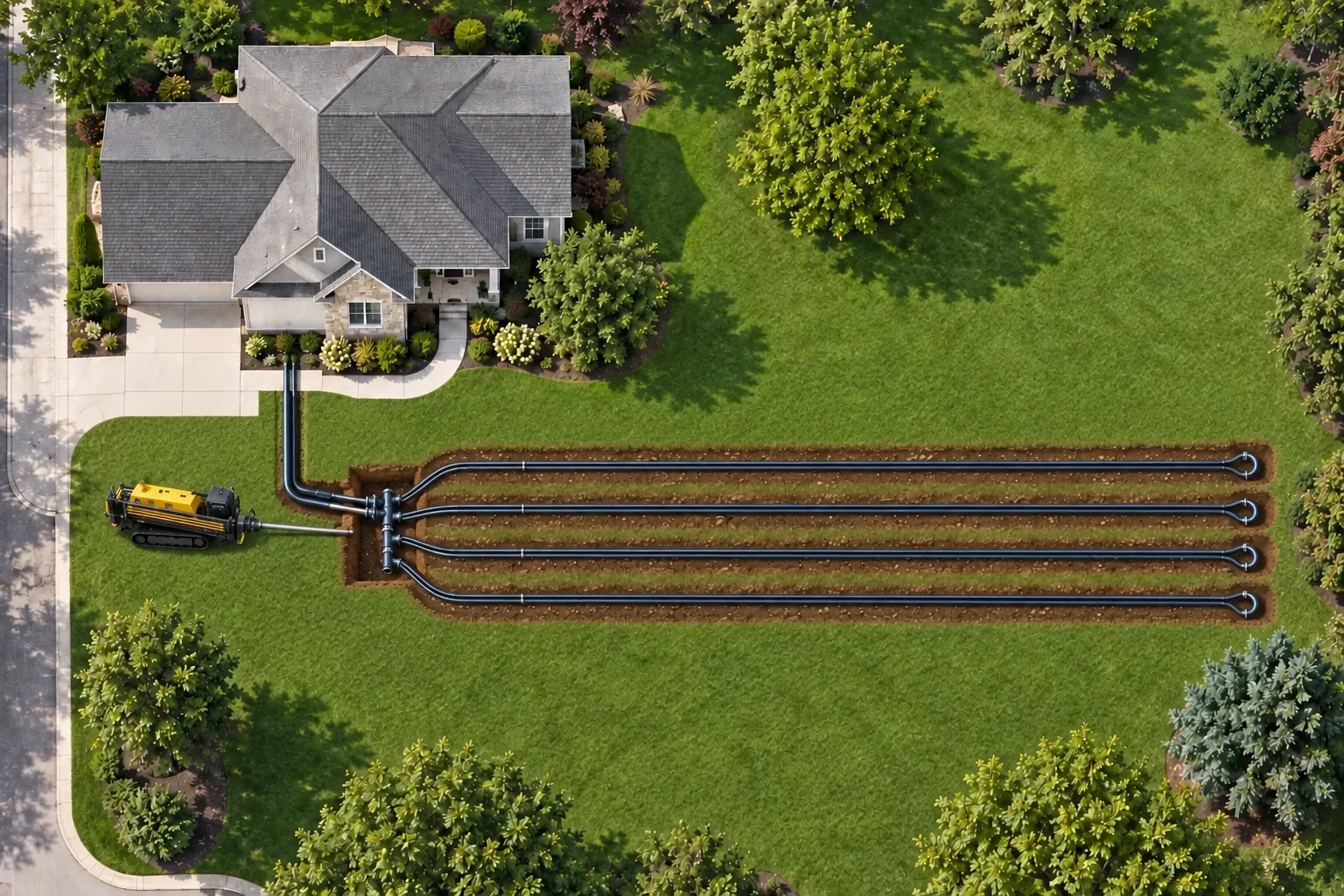
A simplified, not-to-scale overhead view: two header lines run from the home to a manifold pit shown approximately 25 feet into the lawn, feeding four straight conceptual bore circuits shown 15 feet apart. The boring machine is positioned in the grass on the driveway side, and one connected U-bend for each loop emerges at the far side. Actual bore path, depth, spacing, circuiting and capacity require site-specific engineering.
GROUNDWATER-BASED DESIGN
Open loop / well
An open-loop system moves groundwater through the heat pump and discharges it through an approved method. Water quantity, quality and legal discharge are core design inputs—not afterthoughts.
Properties with verified sustainable groundwater yield, acceptable water chemistry, a legal discharge approach and an owner prepared for water-side maintenance.
- Can deliver strong heat-transfer performance
- No buried closed-loop field
- Existing well information may support early screening
- Depends on sustained water yield and pump energy
- Minerals, sediment, corrosion or fouling can require maintenance
- Discharge and permitting can be decisive
Open-loop systems are not currently included in PremiumPath. West Jefferson Plumbing and Heating can still design and install a qualifying open-loop project using cash purchase or traditional financing, subject to well, water-quality, discharge, engineering and lender review.
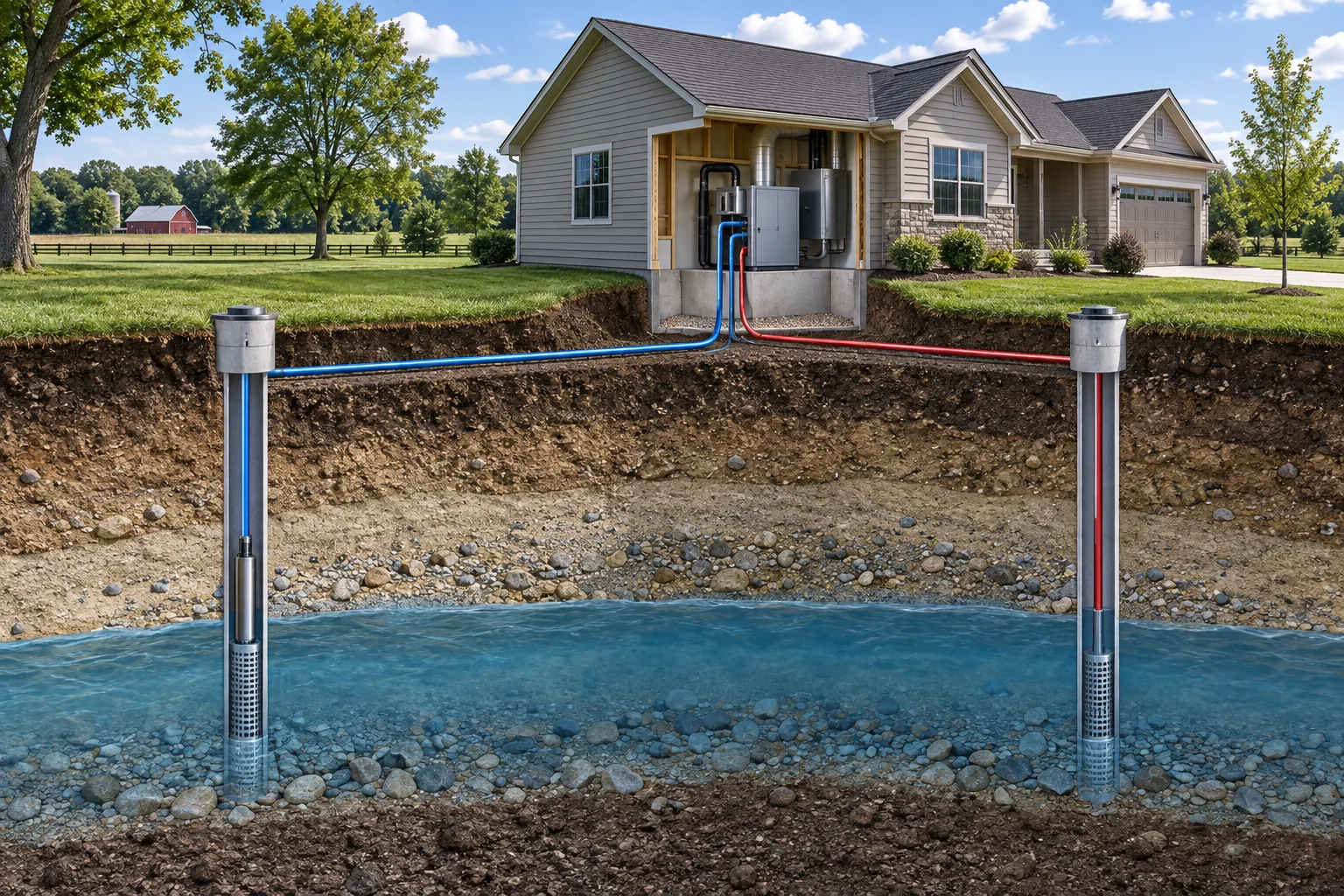
A simplified, not-to-scale supply-and-return-well concept. It is not a well design, proof of water availability, discharge approval or a West Jefferson jobsite photo.
SUBMERGED CLOSED-LOOP FIELD
Pond / lake loop
Closed-loop coils or engineered assemblies are anchored below the water surface, using the water body as the heat-exchange environment while keeping loop fluid isolated.
Properties with a suitable privately controlled water body, dependable depth and volume, safe installation access and acceptable environmental and permitting conditions.
- Little broad land excavation
- Can be effective with a suitable water body
- Closed-loop fluid remains isolated
- Requires adequate year-round depth and volume
- Ownership, permits and ecology can limit use
- Anchoring and underwater access complicate repairs
Pond and lake loops are not currently included in PremiumPath. West Jefferson Plumbing and Heating can still design and install a qualifying pond or lake project using cash purchase or traditional financing, subject to site, water-body, engineering and lender review.
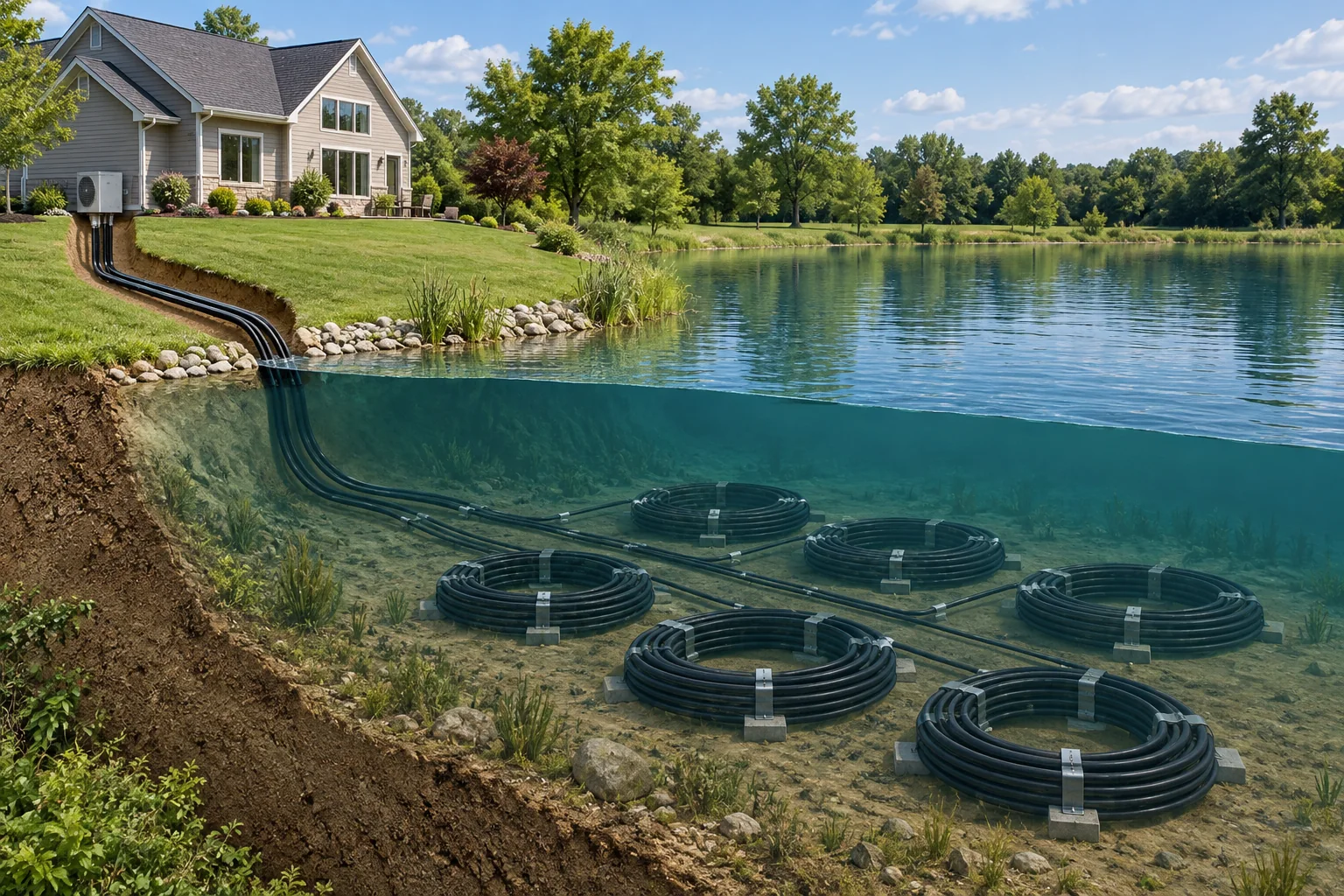
A simplified, not-to-scale submerged-loop concept. Actual coil construction, anchoring, depth, spacing, shoreline routing and capacity require engineering and site verification.
PUBLIC RECORDS
What an Ohio water-well record can—and cannot—tell you.
The Ohio Department of Natural Resources search can provide useful nearby context such as recorded well depth, construction and geology. A nearby record does not prove the available yield, chemistry, drawdown, drilling conditions or legal discharge approach at the project property.
Search official ODNR water-well recordsLearn how to interpret the records →SITE-VERIFIED DESIGN
The online screen narrows the choices. The site walk makes them real.
- Confirm the building load, candidate equipment and required loop capacity.
- Locate utilities, septic areas, wells, structures, easements and protected setbacks.
- Measure drill, excavation, shoreline and header-route access.
- Define restoration limits and identify rock, difficult drilling or restricted access.
- Verify permit authority, final scope, tax and the available ownership or payment path.