
Loop assembly on shore
Show fusion work, coil geometry, weights and pre-installation pressure test.
SUBMERGED CLOSED-LOOP FIELD
Closed-loop coils or engineered assemblies are anchored below the water surface, using the water body as the heat-exchange environment while keeping loop fluid isolated.
GOOD STARTING FIT
Properties with a suitable privately controlled water body, dependable depth and volume, safe installation access and acceptable environmental and permitting conditions.
Pond and lake loops are not currently included in PremiumPath. West Jefferson Plumbing and Heating can still design and install a qualifying pond or lake project using cash purchase or traditional financing, subject to site, water-body, engineering and lender review.
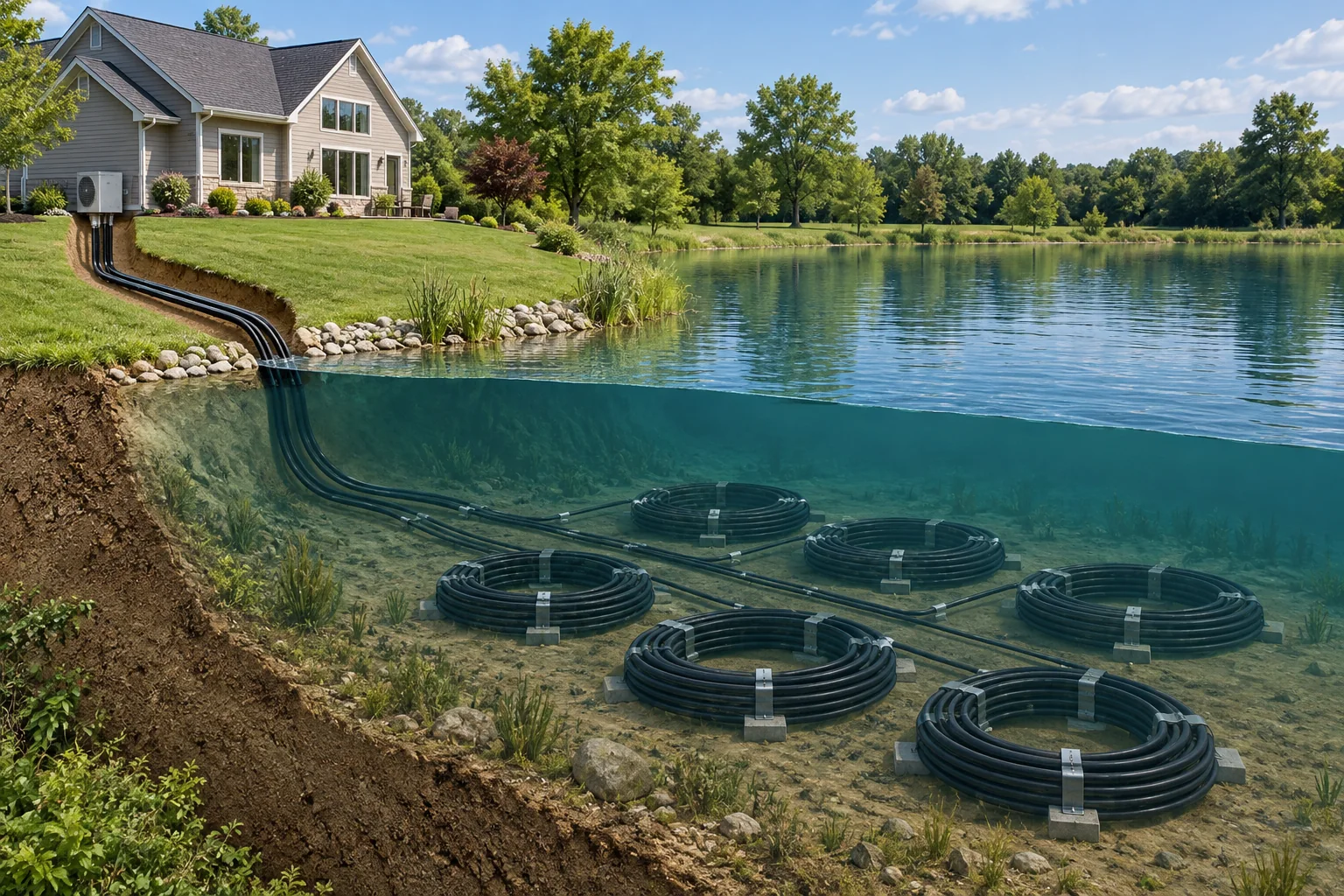
A simplified, not-to-scale submerged-loop concept. Actual coil construction, anchoring, depth, spacing, shoreline routing and capacity require engineering and site verification.
INSTALLATION SEQUENCE
The design verifies water-body ownership, dimensions, seasonal depth, temperature behavior, access and environmental constraints.
Loop assemblies are fused, pressure-tested, floated or moved into position, weighted and anchored at the engineered depth and spacing.
Shore crossings and headers are protected, documented and connected before flushing and commissioning.
PROS
TRADEOFFS
FIELD DOCUMENTATION
A useful project record shows the parts of the loop installation that affect access, performance, restoration and future service. These are the field views we document for this loop type.
Show fusion work, coil geometry, weights and pre-installation pressure test.
Document placement, safe work practices, spacing and controlled sinking.
Capture protected headers, erosion control and restored shoreline.
SITE VERIFICATION
FROM SCREENING TO SITE DESIGN